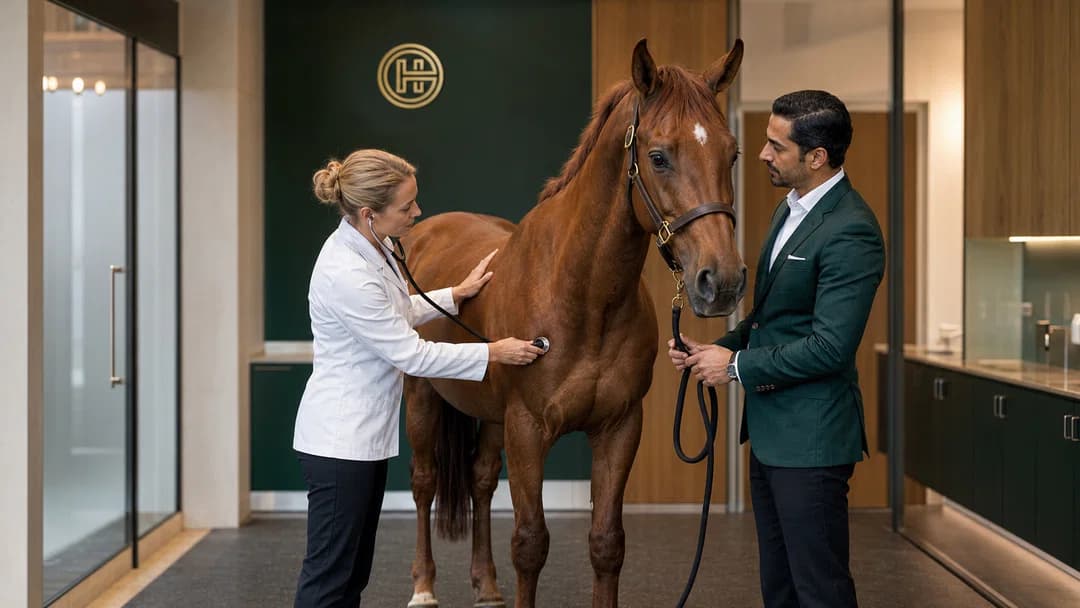
Buying a horse is an important sporting, financial and emotional decision. A successful trial and impressive competition videos can create confidence, but they cannot provide a complete picture of the horse’s current health.
A pre-purchase examination—often called a PPE or horse vetting—is designed to give the buyer structured, independent veterinary information before deciding whether to proceed.
It can reduce uncertainty and identify relevant risks. It cannot remove every risk or guarantee the horse’s future health and performance.
What Is a Pre-Purchase Examination?
A pre-purchase examination is performed at the request of a prospective buyer or their authorised agent. Its purpose is to assess the horse at the time of the examination, taking into account what the buyer intends to do with it.
The intended use matters enormously. The same finding may have different significance for:
A leisure horse
A young jumping prospect
An amateur competition horse
A Grand Prix show jumper
A breeding mare or stallion
A horse intended for resale
The Royal College of Veterinary Surgeons describes a PPE as an assessment that assists the purchasing decision and provides an indication—not a guarantee—of suitability for the intended use.
A PPE is therefore not a universal certificate saying that a horse has “passed” or “failed.” It is an assessment made for a particular buyer, horse and purpose at a particular moment.
Who Should Choose the Veterinarian?
The buyer should appoint a qualified equine veterinarian who can act independently and in the buyer’s interests.
Ideally, the examining veterinarian should not have a relationship with the seller that could create a conflict of interest. If the veterinarian or practice has previously treated the horse or regularly works for the seller, that connection should be disclosed to the buyer before the examination.
The buyer can then decide whether they are comfortable proceeding or would prefer another veterinarian.
Both the RCVS and the American Association of Equine Practitioners emphasise independence, impartiality and clear disclosure during purchase examinations.
Hiplando can help identify and coordinate with an appropriate veterinarian, but the veterinary assessment must remain independent.
Tell the Veterinarian What You Need
Before the examination, the buyer should explain the horse’s intended purpose clearly.
Useful information can include:
Discipline
Current and intended competition level
Rider experience
Expected training intensity
Whether the horse is intended for professional or amateur use
Any concerns noticed during the trial
Relevant videos or competition history
Whether insurance will be required
Any specific tests requested by the buyer or insurer
A veterinarian cannot assess risk properly without understanding what will be expected from the horse.
A finding that may be manageable for one purpose could be more significant for another. This is why a previous veterinary certificate prepared for a different buyer should not automatically be treated as sufficient.
What Happens During the Examination?
The format of a pre-purchase examination varies between countries and may be adapted according to the horse, intended use, available facilities and professional judgement of the veterinarian.
In the United Kingdom, recognised examinations may be conducted in two or five stages. The British Equine Veterinary Association’s five-stage framework provides a useful explanation of a comprehensive clinical process.
Stage One: Preliminary Examination
The horse is examined at rest. The veterinarian confirms its identity and evaluates its general condition and baseline clinical findings.
The horse’s passport, markings and microchip may be checked when the necessary documents and equipment are available.
The veterinarian may also ask about the horse’s history, current management and any known medical information.
Stage Two: Walk and Trot in Hand
The horse is observed walking and trotting in hand, usually on an appropriate firm, level surface.
This allows the veterinarian to evaluate movement, straightness, gait quality and any visible abnormalities before the exercise phase.
Stage Three: Exercise
The horse is exercised under suitable conditions, normally ridden or lunged depending on the circumstances.
The purpose is to evaluate the horse during physical work and identify findings that may not be apparent while it is standing or moving slowly in hand.
A suitable rider, safe exercise area and appropriate footing should be available.
Stage Four: Rest and Re-Examination
After exercise, the horse is allowed to rest and is examined again.
The veterinarian evaluates how the horse recovers and whether any relevant findings become apparent following exercise.
Stage Five: Second Trot-Up
The horse is trotted in hand again after exercise and rest.
This provides a final opportunity to reassess movement and identify any change compared with the earlier examination.
If any part of the examination cannot be completed, the limitation and its potential significance should be recorded and explained to the buyer.
Are X-Rays Automatically Included?
Radiographs are commonly requested during high-value sport-horse purchases, but they are additional diagnostic procedures rather than a replacement for the clinical examination.
The appropriate number and location of radiographs depend on factors such as:
The horse’s age
Discipline and intended level
Clinical findings
Previous medical history
Purchase value
Buyer’s concerns
Insurance requirements
Veterinarian’s professional judgement
Other additional procedures may include:
Ultrasound examinations
Upper-airway endoscopy
Blood sampling or laboratory testing
Targeted diagnostic imaging
Reproductive examinations for breeding horses
Other tests recommended by the veterinarian
More tests do not automatically produce a simple answer. Every finding must be interpreted in the context of the horse, its history and its intended use.
The AAEP purchase-examination guidelines state that abnormal or undesirable findings should be recorded and their significance explained. Procedures recommended but not performed should also be documented.
Can Existing X-Rays Be Used?
Existing radiographs can provide useful historical information, but several questions should be considered:
When were they taken?
Can the horse’s identity be confirmed?
Is the image quality sufficient?
Which anatomical areas were included?
Have the original files been provided?
Who interpreted the images?
Has the horse’s work level changed since they were taken?
The buyer’s veterinarian may recommend reviewing the original images, repeating certain views or taking an entirely new set.
A seller’s radiographic report should not replace an independent interpretation made for the individual buyer. The AAEP specifically recommends that radiographs be interpreted by a veterinarian representing the buyer’s interests and considering that buyer’s needs and risk tolerance.
What Can a Vet Check Not Guarantee?
Even a thorough examination has limitations.
A PPE cannot guarantee:
Future soundness
Future competition performance
That an injury will never occur
That no medical condition exists
The horse’s behaviour in every environment
Long-term compatibility between horse and rider
That the horse will pass a future insurance examination
The examination reflects the horse’s condition and the information available on that particular day.
Some conditions may be intermittent, not clinically apparent or outside the agreed examination scope. This is why buyers should understand which procedures were performed, which were omitted and what limitations remain.
Understanding the Results
Veterinary findings should not be reduced immediately to “good” or “bad.”
A radiographic change or clinical observation may:
Have little relevance to the intended use
Require monitoring
Influence future management
Affect insurance coverage
Justify further investigation
Represent a level of risk the buyer does not wish to accept
The veterinarian should explain the findings and their possible significance. The final purchasing decision remains with the buyer, taking into account veterinary advice alongside the horse’s suitability, price, performance, temperament and intended purpose.
A horse does not need perfect radiographs to be the right purchase. Equally, attractive radiographs do not guarantee future soundness.
Questions Buyers Should Ask
After receiving the results, buyers may wish to ask:
Which findings are most relevant to my intended use?
Are any additional tests recommended?
Were any requested procedures not completed?
Is further specialist interpretation advisable?
Could any findings affect insurance?
Are there management or monitoring considerations?
Should any examination be repeated before purchase?
Can I receive the written report and diagnostic files?
Whenever possible, the buyer should speak directly with the examining veterinarian instead of relying on information passed through the seller or an agent.
How Sellers Should Prepare
The seller or person presenting the horse should help provide suitable conditions for an effective examination.
Preparation may include:
Having the horse’s passport and identification available
Providing a safe, well-lit examination area
Providing suitable surfaces for walking and trotting
Making an arena and competent rider available when required
Presenting the horse in its normal condition
Answering questions honestly
Disclosing known medical and management information
Authorising access to relevant records when appropriate
Providing permission for agreed additional procedures
The seller should not attempt to influence the veterinarian’s conclusions. Transparent cooperation gives the buyer greater confidence in both the horse and the sale.
Buying a Horse Internationally
International purchases require additional organisation.
Before booking the examination, confirm:
Which country’s examination format will be used
The veterinarian’s experience and qualifications
The exact scope of the examination
Available facilities
Which imaging equipment is available
The language of the report
How images and documents will be transferred
Whether the buyer can attend by video call
Any insurance requirements
The timeline for the sale and transport
The BEVA guidance specifically recognises that examinations performed abroad require additional planning and may need to account for different professional and legal frameworks.
A pre-purchase examination should not be confused with the health documents or official certification required for international transport. Those requirements must be organised separately.
Hiplando’s Role
Hiplando can coordinate communication between the buyer, seller and independent veterinarian.
Depending on the sale, this may include:
Scheduling the examination
Confirming the buyer’s intended use
Coordinating access to the horse
Helping transfer records with proper authorisation
Arranging video attendance
Coordinating additional imaging
Supporting communication after the report
Planning the next steps, payment and transport
Hiplando does not replace the veterinarian, interpret medical findings or guarantee a horse’s health. Our role is to help ensure that the process is organised, transparent and properly communicated.
Make an Informed Decision
A pre-purchase examination is not about finding a flawless horse. It is about understanding the available information and deciding whether the horse and its associated risks are appropriate for the buyer’s goals.
The strongest purchases combine:
A suitable horse-and-rider match
An honest seller
Independent veterinary advice
Clear written terms
Professionally organised transport
To discuss a horse purchase, veterinary examination or trial, contact Hiplando directly on WhatsApp or email [email protected].
This article provides general educational information and is not a substitute for advice from a qualified veterinarian familiar with the individual horse and transaction.