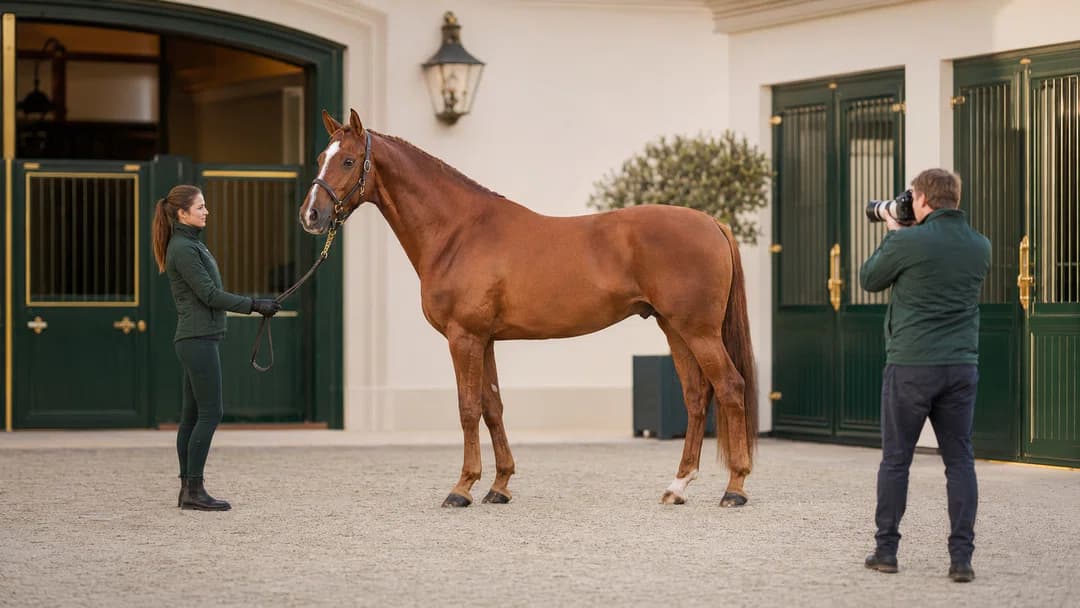
Chestnut sport horse being professionally photographed for an international sales listing.
Selling a horse successfully requires much more than posting a short jumping video with a telephone number.
Professional presentation helps the right buyers understand the horse, compare it with their requirements, and decide whether it deserves a trial. It also protects the seller from unsuitable enquiries and unnecessary negotiations.
The objective should never be to make every horse look perfect. It should be to present the horse accurately, attract the correct audience, and create confidence from the first contact.
Professional Presentation Begins With Trust
Serious buyers want clear information. When important details are missing, they may assume there is something the seller does not want to disclose.
A professional listing should answer the buyer’s most important questions before they need to ask them.
1. Prepare the Complete Horse Information
Before publishing the listing, collect all the essential details in one place:
Horse’s registered name.
Year of birth and age.
Gender.
Height.
Sire and dam’s sire.
Studbook.
Current and previous competition level.
Recent results.
Location.
Asking price.
Veterinary information currently available.
Passport and ownership information.
Reason for sale.
Seller’s authorization to advertise the horse.
At Hiplando, the price and location must be included. Listings using “DM for price” are not accepted.
Clear information saves time and allows buyers to understand immediately whether the horse corresponds with their search.
2. Write an Honest and Relevant Description
The description should explain more than the horse’s age and jumping level.
Describe the horse’s temperament, rideability, experience, strengths, and the type of rider for whom it may be suitable.
For example, explain whether the horse is:
Suitable for an amateur, junior, young rider, or professional.
Forgiving after a rider’s mistake.
Careful, powerful, fast, or naturally competitive.
Experienced at different venues.
Comfortable travelling and competing internationally.
A schoolmaster, young prospect, speed horse, or Grand Prix prospect.
Avoid exaggerated descriptions such as “perfect for everyone” or “guaranteed future champion.” Even an exceptional horse will not suit every rider.
An honest description builds trust and increases the chance of creating the correct horse-and-rider match.
3. Use Professional Photographs
Photographs create the buyer’s first visual impression.
The horse should be clean, correctly groomed, and presented with appropriate equipment. Choose an uncluttered location with good natural light and a safe, professional background.
A complete sales presentation should ideally include:
A clean conformation photograph from the side.
A clear photograph of the horse’s head.
Photographs under saddle.
High-quality action photographs.
Recent competition photographs when available.
Heavy filters, artificial backgrounds, and excessive editing should be avoided. Buyers need to see the real horse—not a version that has been digitally altered beyond recognition.
4. Provide Complete and Recent Videos
One impressive jump is not enough to evaluate a horse.
A useful sales video should show the horse’s natural movement, rideability, technique, and behaviour throughout the session.
Include:
Walk, trot, and canter in both directions.
Transitions and changes of lead.
Basic flatwork.
Warm-up fences.
A complete course at an appropriate height.
Recent competition rounds.
The horse’s behaviour before and after jumping.
Whenever possible, provide full, uncut rounds in addition to a shorter promotional edit.
The horse should be filmed in good light, with a steady camera and a clear view of the complete obstacle. Old footage should be identified honestly rather than presented as recent.
5. Support Claims With Results
If the horse has competition experience, provide links to its official results.
Buyers should be able to compare the description with the horse’s real performance record. Include results from the FEI, national federation, or another recognized competition database whenever available.
Do not describe a horse as competing consistently at a certain level based only on one appearance. Clearly distinguish between:
The horse’s current competition level.
The highest level it has completed.
Its experience at home.
Its potential for the future.
Potential is an opinion. Competition results are evidence. A professional listing should make the difference clear.
6. Be Transparent About Veterinary Information
Veterinary transparency is essential in an important horse transaction.
If recent radiographs, clinical examinations, blood tests, or other documents are available, explain what can be shared and under which conditions.
Known veterinary findings, previous treatments, maintenance requirements, or relevant medical history should not be deliberately hidden.
A finding does not automatically make a horse unsuitable. Its significance depends on the horse’s intended use, age, performance level, and the independent veterinarian’s assessment.
The buyer should always have the opportunity to appoint an independent veterinarian for a pre-purchase examination.
7. Set a Realistic Asking Price
The asking price should reflect the horse’s complete profile, including:
Age and experience.
Competition record.
Pedigree.
Rideability and temperament.
Veterinary information.
Current market demand.
Location.
Suitability for amateur or professional riders.
A clear price attracts enquiries from buyers with an appropriate budget. Hiding the price often creates unnecessary conversations and discourages serious clients.
The highest possible asking price is not always the best strategy. An unrealistic price can keep a suitable horse on the market for too long and reduce buyer confidence.
8. Prepare Properly for Viewings and Trials
When a serious buyer arranges a viewing, the horse should be presented under normal and transparent conditions.
The buyer should be able to:
See the horse in the stable.
Observe it being handled and prepared.
Watch the regular rider demonstrate it.
Ride the horse personally when appropriate.
Test it at a suitable level without unnecessary over-jumping.
Ask detailed questions about its history and management.
Arrange an independent veterinary examination.
Passports, ownership documents, results, and available veterinary records should be organized before the trial.
Common Mistakes That Reduce Buyer Confidence
Sellers should avoid:
Publishing without a price or location.
Using only one short highlight video.
Providing unclear or contradictory information.
Advertising without the owner’s authorization.
Using old media without mentioning when it was recorded.
Making unrealistic claims about the horse’s level.
Refusing an independent veterinary examination.
Hiding known behavioural or veterinary information.
Pressuring buyers to transfer money immediately.
Professional communication is as important as professional media.
How Hiplando Supports Horse Sellers
Hiplando helps sellers present horses professionally and reach suitable buyers through an international equestrian network.
Our support can include:
Preparing the horse’s sales profile.
Reviewing photographs, videos, and information.
Publishing the horse through the Hiplando platform and network.
Introducing the horse to suitable international clients.
Managing buyer enquiries.
Coordinating trials and veterinary examinations.
Supporting documentation and sale arrangements.
Organizing international horse transportation.
Our objective is not simply to create more enquiries. It is to connect the seller with serious buyers who are genuinely searching for that type of horse.
Would you like to present your horse through Hiplando?
Send us the horse’s complete information, price, location, photographs, videos, and available results:
https://wa.me/message/6BETXVJD76LPN1
Hiplando — Buy. Sell. Connect.